
Nike is being removed from the S&P 100 while remaining in the S&P 500.
That is an important distinction.
The company is not leaving the broader large-cap index.
It is losing its place in the more concentrated group of America's largest blue-chip companies.
We looked at similar removals to see what happened next.
Thirteen comparable removals
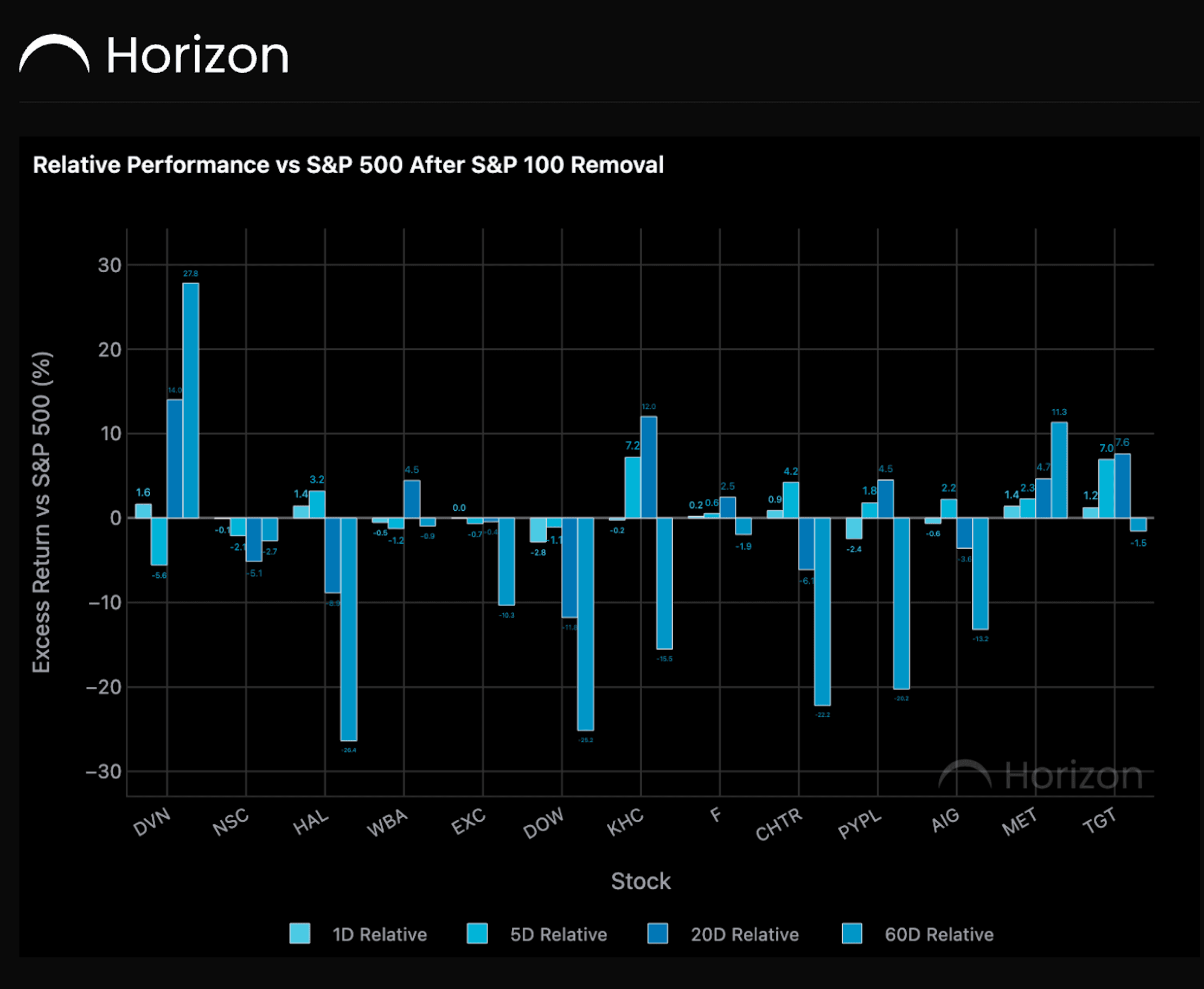
We found 13 S&P 100 removals from 2016 through 2026 where the company remained in the S&P 500.
The immediate reaction was limited.
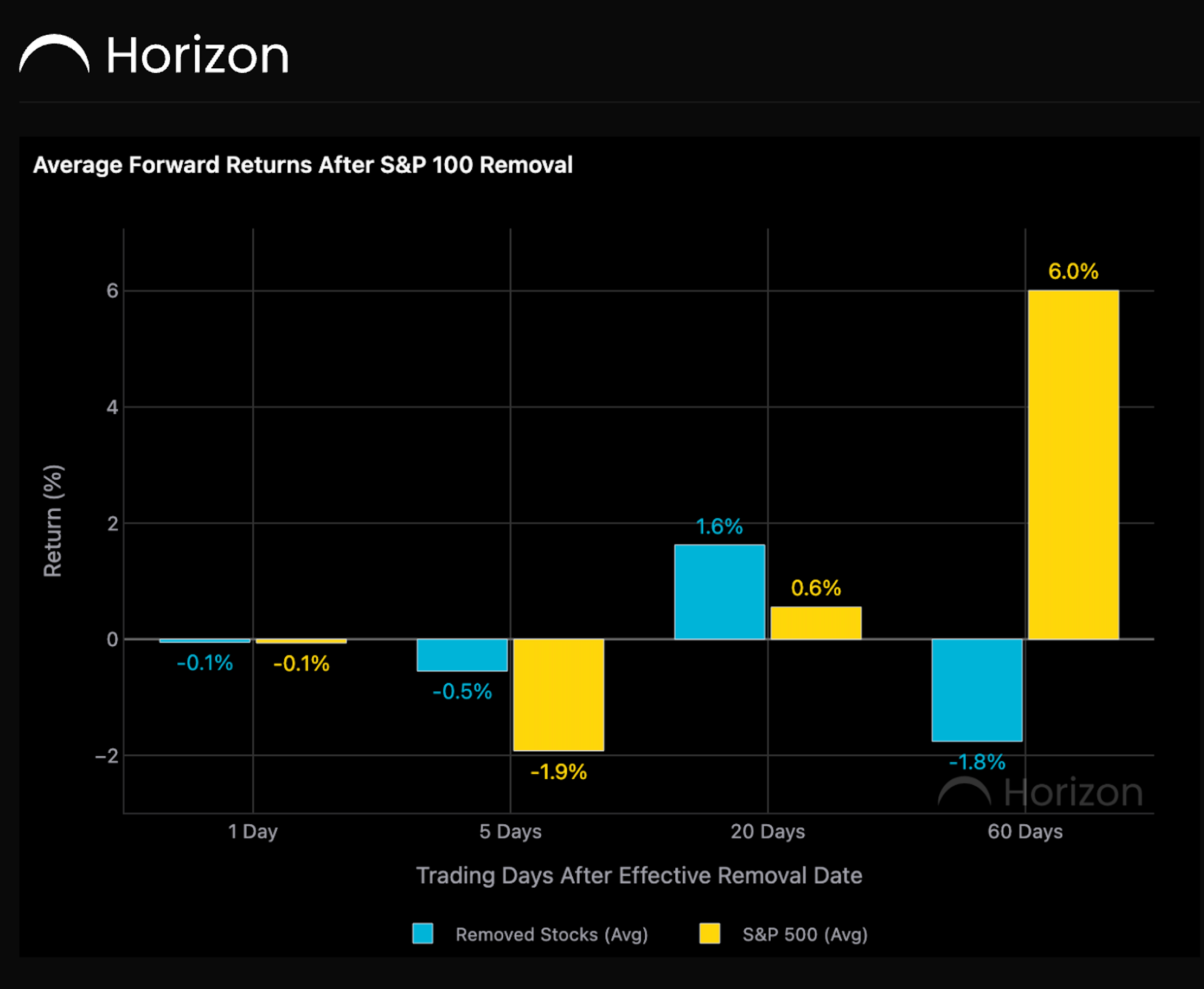
One day after removal, the average removed stock was down 0.1%, exactly in line with the S&P 500.
Five days later, the removed stocks were down 0.5%, while the index was down 1.9%.
At 20 days, the removed stocks were up 1.6%, compared with 0.6% for the S&P 500.
So there was no obvious short-term penalty.
The weakness appeared later
By 60 trading days, the pattern changed.
The average removed stock was down 1.8%.
The S&P 500 was up 6.0%.
That is a relative gap of roughly 7.8 percentage points.
Only two of the 13 stocks outperformed the S&P 500 over the full 60-day window.
Several lagged the index by more than 20 percentage points.
That is the strongest result in the study.
Why the effect may take time
Index removal creates some mechanical selling, but Nike is still remaining inside the S&P 500.
That limits the amount of forced selling compared with a full removal from the broader index.
The more important signal may therefore be what the removal represents.
Companies leave the S&P 100 because they are no longer among the largest and most prominent names in the market.
That can coincide with a period of weaker relative performance that continues after the rebalance itself.
In other words, the removal may be more symptom than cause.
What this means for Nike
History does not suggest Nike should experience a dramatic one-day selloff simply because it is leaving the S&P 100.
The more relevant question is whether its relative weakness persists over the following two to three months.
That is where the comparable removals performed worst.
The takeaway
The immediate S&P 100 removal effect has historically been modest.
The medium-term pattern has been much weaker.
Across 13 comparable removals, the average stock lagged the S&P 500 by roughly 7.8 percentage points over the following 60 trading days.
For Nike, the index change itself may not be the important event.
The more interesting signal is whether losing large-cap leadership status coincides with continued relative weakness.
Share this post: