
Nvidia is back in the middle of the U.S.-China chip story.
On September 27, The Information reported that China is considering allowing companies including ByteDance and Alibaba to buy Nvidia's RTX Pro 5500 chips. China's industry ministry has reportedly asked companies about their purchase plans, with some told that Beijing intends to approve purchases. Reuters could not independently verify the report.
The obvious question is what that could mean for Nvidia's shares.
China chip news has moved Nvidia before
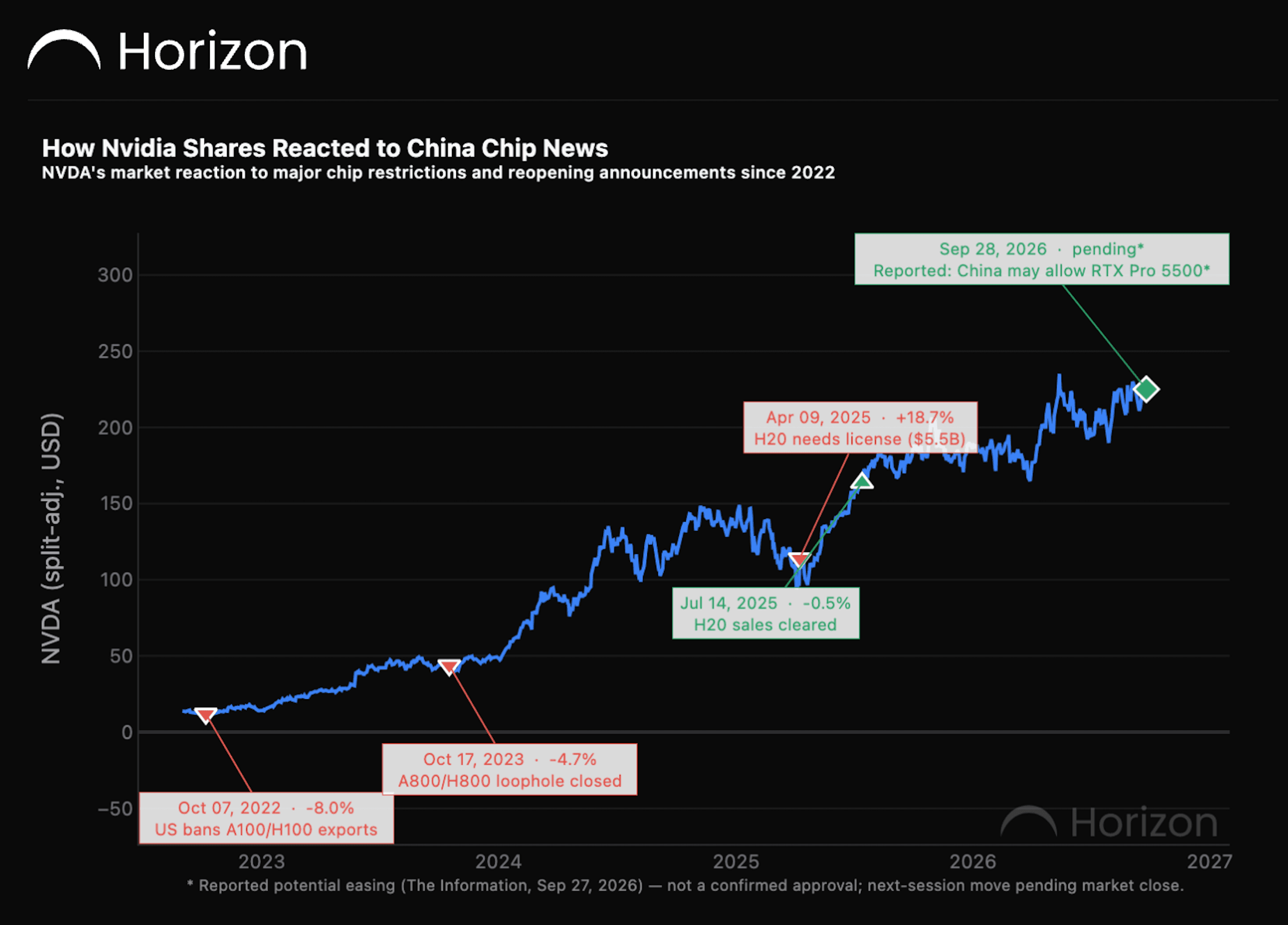
We looked at several major restriction and reopening events since 2022 and measured Nvidia's market reaction around each one.
The first two major restrictions produced clear negative reactions. When the U.S. banned exports of Nvidia's A100 and H100 chips to China in October 2022, NVDA fell 8.0%. When Washington tightened the rules again in October 2023, closing the A800 and H800 route into China, the stock fell 4.7%.
But the relationship became less straightforward in 2025.
On April 9, Nvidia was informed that exports of its H20 chip would require a license, a restriction ultimately associated with a $5.5 billion charge. The charted session around that event shows NVDA up 18.7%, illustrating how broader market forces can overwhelm a single policy headline.
Then, when H20 sales were cleared again in July 2025, NVDA's measured reaction was just -0.5%.
The latest reopening could be another test
The September 27 report potentially opens another route into China, this time through Nvidia's RTX Pro 5500.
This is not a confirmed approval. The reported development is therefore marked as pending until the next U.S. trading session provides a measurable market reaction.
That next observation matters because the historical record is mixed.
The early restrictions coincided with sharp declines, but later events did not produce a consistent restriction-down, reopening-up relationship. China access can be financially significant for Nvidia without every policy change translating directly into the stock price.
Takeaway
China chip policy matters to Nvidia, but the immediate share-price response has not been consistent.
The first two major restrictions in our sample were followed by declines of 8.0% and 4.7%. Later policy changes produced very different reactions.
The latest reported easing gives us another live test. Once the market reacts, we can add the result to the same framework rather than assuming the direction in advance.
Share this post: