
Nvidia earnings are among the most closely watched events in the market.
The stock can move sharply, but the broader question is what usually happens after the print and how much of that move actually spills into the rest of the market.
We looked at 42 Nvidia earnings reports since 2016.
Nvidia has shown a positive post-earnings drift
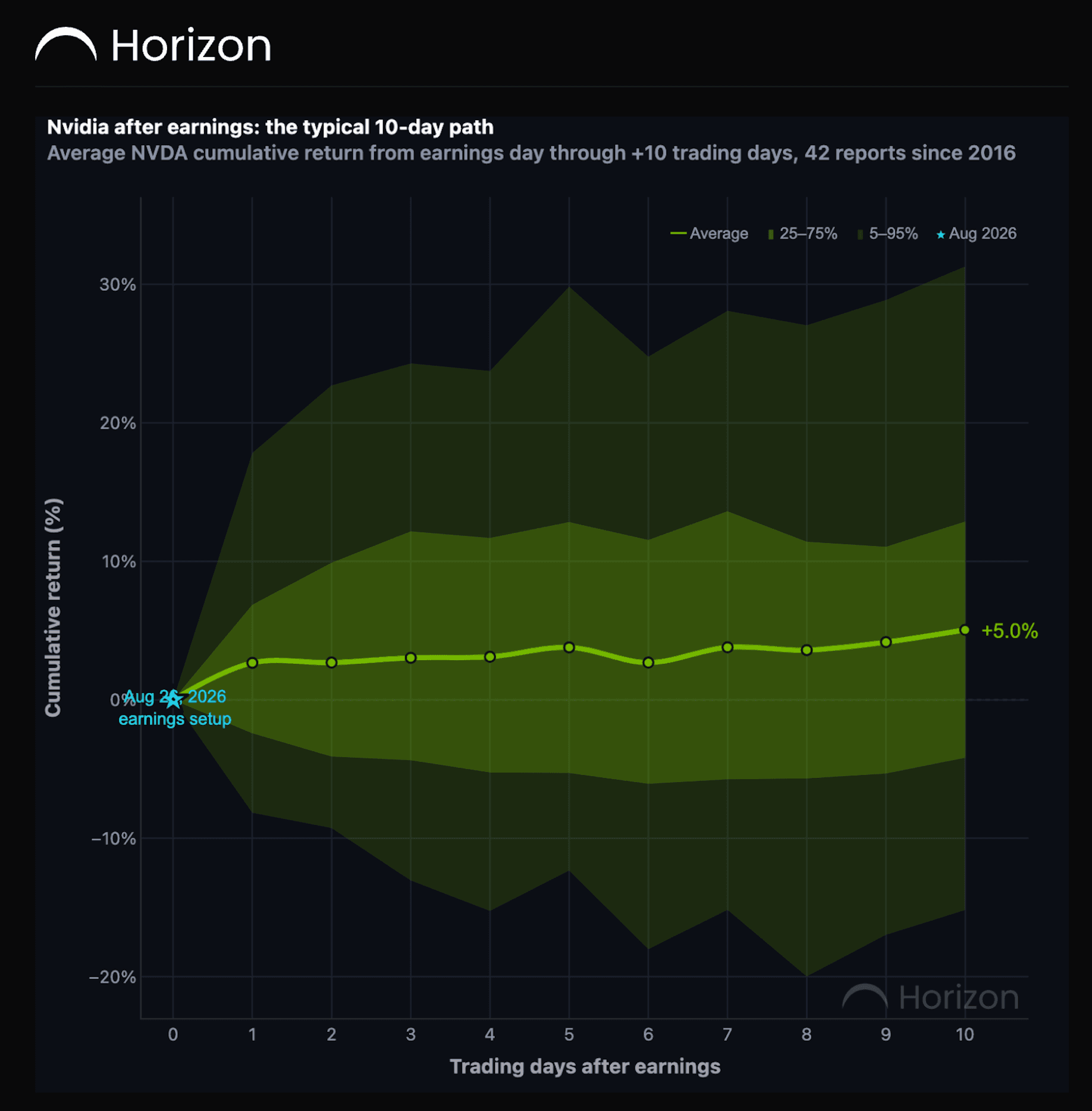
Across the full sample, NVDA averaged:
- Day +1: +2.67%
- Day +5: +3.79%
- Day +10: +5.05%
The average path remained positive throughout the full 10-trading-day window.
That is a clear historical bias.
The dispersion, however, was wide.
By Day +10, the middle 50% of outcomes ranged from roughly -4.19% to +12.88%.
So the average has been strong without being remotely deterministic.
The stock moves much more than the market
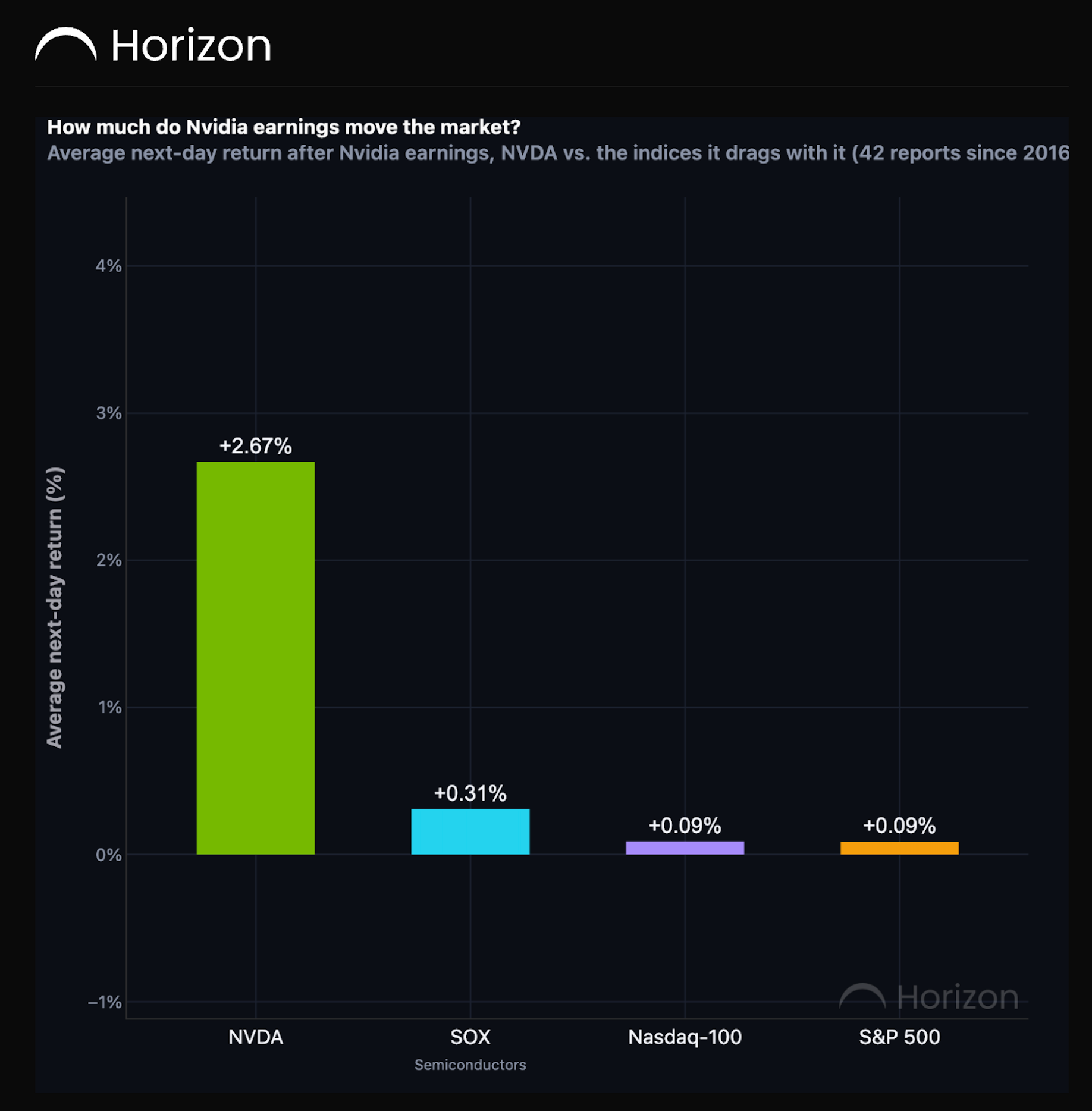
Across the same 42 reports, average next-day returns were:
- NVDA: +2.67%
- SOX / SOXX: +0.31%
- Nasdaq-100: +0.09%
- S&P 500: +0.09%
That is the more surprising result.
Nvidia can dominate headlines around AI and semiconductors without producing a similarly large directional move in the wider market.
The stock's own earnings sensitivity has historically been far greater than the spillover into the indexes around it.
Why the broader impact is smaller
Nvidia is important, but broad indexes are diversified.
A large move in one company can be offset by different reactions elsewhere.
The market may also interpret Nvidia's results as highly company-specific, especially when expectations are already extreme.
That means a huge NVDA move does not automatically translate into an equally strong read-through for the entire Nasdaq or S&P 500.
What to watch after the print
The historical benchmark is simple.
NVDA has tended to drift higher over the following 10 sessions.
The broader market has not shown anything close to the same average response.
That makes the post-earnings path of Nvidia itself more informative than assuming the entire market should move in tandem.
The takeaway
Across 42 Nvidia earnings reports since 2016, the stock averaged +2.67% by Day +1 and +5.05% by Day +10.
The post-print bias has historically been positive.
The wider market impact has been much smaller.
Nvidia moves Nvidia far more consistently than it moves the market around it.
Share this post: