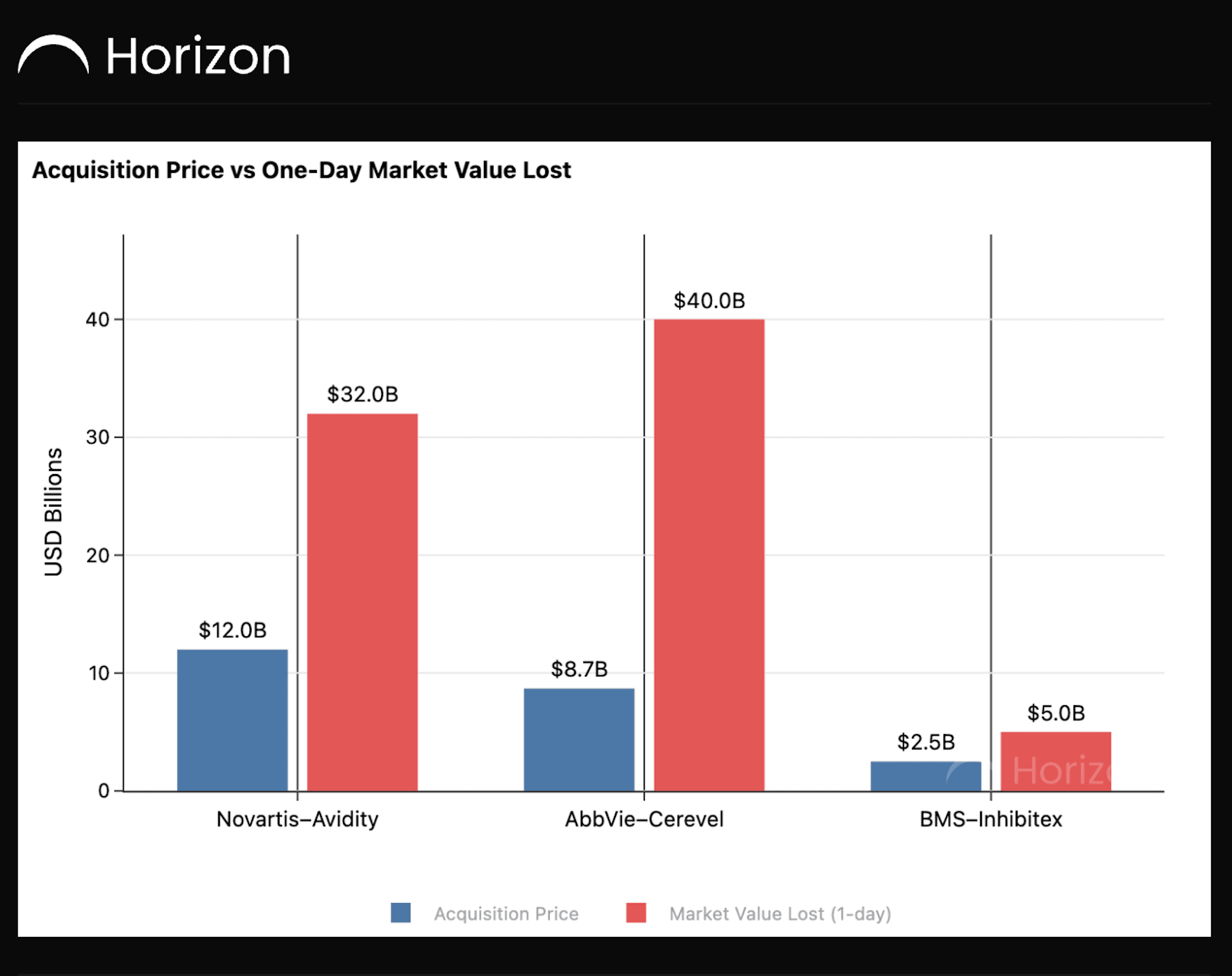
Novartis paid about $12 billion for Avidity.
After del-desiran failed Phase III, Novartis lost roughly $32 billion of market value in a single day.
The loss was almost three times the value of the original acquisition.
It sounds extreme.
It is not the only example.
Three clean comparable deals
We looked at three major pharmaceutical acquisitions where a strategically important acquired drug later suffered a major clinical failure.
In every case, the one-day market-value loss exceeded the price originally paid for the acquisition.
Novartis and Avidity produced a loss equal to roughly 2.67 times the deal value.
Bristol Myers Squibb's Inhibitex outcome was about 2.00 times.
AbbVie's Cerevel case was even larger at roughly 4.60 times the acquisition value.
Why can the loss exceed the purchase price?
The acquisition price is not the maximum value the market can assign to the asset.
After a deal closes, investors build future revenue, margins and strategic value into the acquirer's share price.
A successful drug can become worth far more than what the company originally paid for the business that developed it.
That means a later clinical failure can destroy not only the accounting value of the acquisition, but also years of expected future cash flows that investors had already priced in.
The market is unwinding expectations, not simply writing off the original cheque.
Pipeline concentration makes the reaction worse
The more important the acquired drug is to the strategic logic of the deal, the more severe the repricing can become.
If investors viewed the asset as a central future growth driver, a failed trial can affect the entire earnings outlook.
It can also raise questions about management's capital allocation and the rest of the pipeline.
That is why a single clinical result can move tens of billions of dollars in market value.
Novartis was severe, but not unprecedented
Losing roughly $32 billion after paying around $12 billion for Avidity looks extraordinary.
The AbbVie and Cerevel example was even more punitive relative to the original deal size.
That makes the Novartis reaction less of an isolated anomaly and more of an example of how aggressively pharmaceutical markets can reprice failed acquired assets.
The takeaway
In all three clean comparable cases, the one-day loss in market value exceeded the original acquisition price.
The market can destroy multiples of the deal value because investors are not valuing the historical purchase price.
They are valuing the future cash flows they expected the acquired drug to generate.
When that expectation disappears in a single clinical result, the repricing can be brutal.
Share this post: