
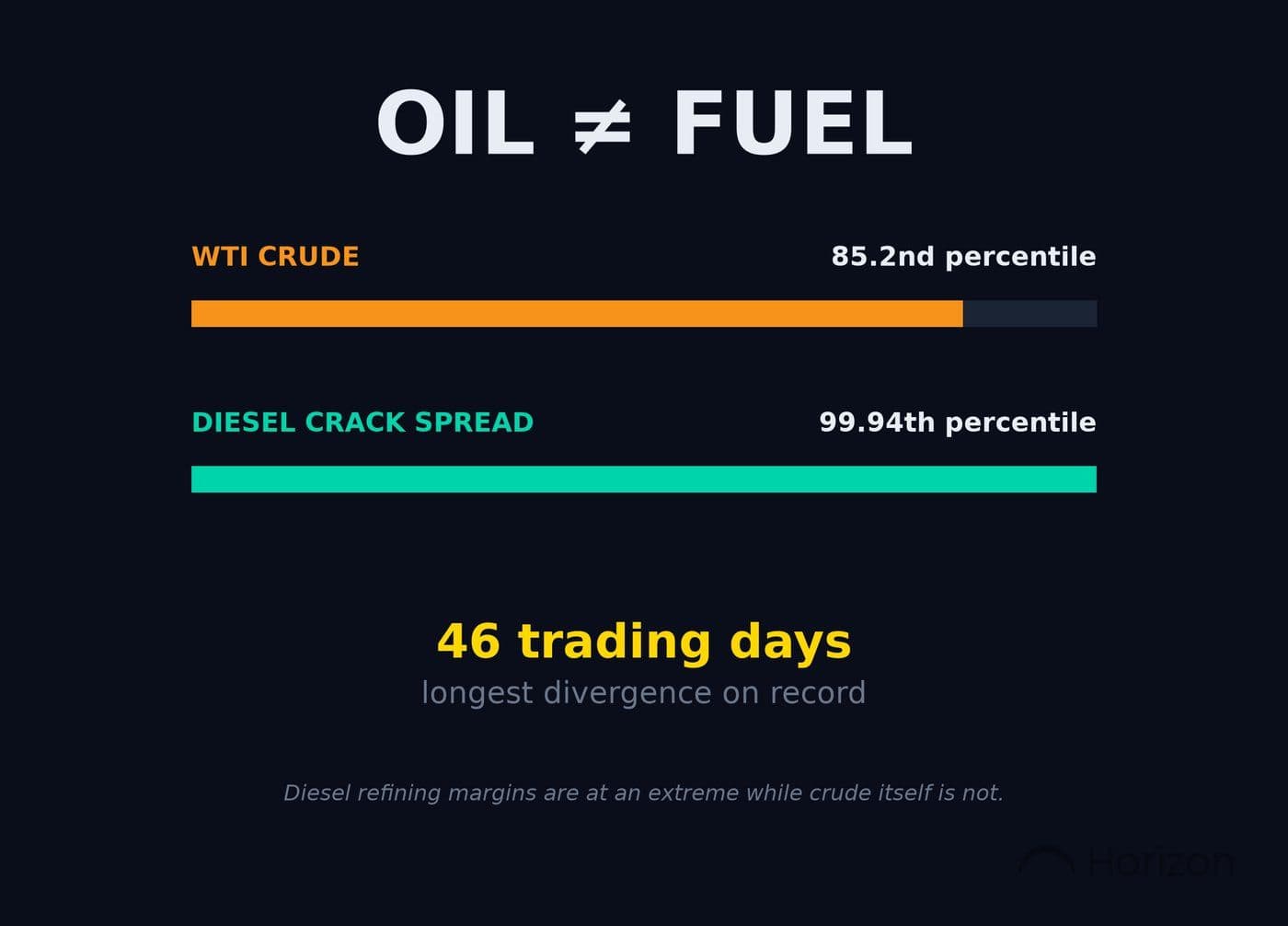
WTI crude is trading around $93.70 per barrel.
That is elevated, but not extraordinary. It sits around the 85th percentile of its historical range.
The diesel crack spread is a very different story.
At $103.95 per barrel, it sits around the 99.94th percentile.
That gap between crude prices and refining margins has now persisted for 46 trading days, the longest episode in the dataset.
Crude is expensive. Refining is extreme.
The important distinction is that oil and fuel are not the same trade.
Crude oil is the raw input.
Refined products such as diesel reflect not only the cost of crude, but also refining capacity, outages, transport bottlenecks and end-market demand.
That means refining margins can explode even when crude itself is not at an extreme.
That is exactly what the current data shows.
What happened in similar episodes
Since 2000, there have been 32 qualifying episodes where diesel crack spreads were in the top 1% of their historical range while crude remained below its 90th percentile.
Over the following 20 trading days, an equal-weight basket of Valero, Marathon Petroleum and Phillips 66 outperformed the S&P 500 by 5.92% on average.
The hit rate was 65.6%.
That is a meaningful result.
The edge weakens with stricter sampling
Overlapping events can exaggerate a signal because several nearby days may all belong to the same underlying market regime.
To reduce that effect, we also tested a stricter non-overlapping sample.
That left 16 events.
Average relative outperformance fell to 3.85%, with a 56.3% hit rate.
The edge was still positive, but much weaker.
That is why this should not be treated as a mechanical trade signal.
Why refiners can benefit
When refined-product prices rise much faster than the cost of crude, refinery economics improve.
The difference between the price of the finished product and the cost of the input is effectively the margin opportunity.
If that spread remains elevated, refiners can capture stronger earnings even without crude moving much higher.
The current setup is notable because the refining margin is historically extreme while the crude input remains below its own extreme range.
The takeaway
The current divergence between crude oil and diesel refining margins is unusually large and unusually persistent.
Historically, similar regimes have tended to favour U.S. refiners relative to the broader market.
The signal is not perfect, and the edge weakens materially after removing overlapping episodes.
But the core point is clear: the interesting part of the current oil market is not just the price of crude.
It is how much more extreme the economics of turning that crude into fuel have become.
Share this post: