
When headline retail sales turn negative, investors often look inside the report for evidence that the consumer is healthier than the top-line number suggests.
One of the most common narratives is strong e-commerce.
If nonstore retail sales remain positive while the headline falls, the assumption is that the initial market selloff may be an overreaction.
The data does not support that idea.
Thirty-one negative retail sales releases
We tested 31 negative U.S. retail sales releases using SPY tick data from May 2018 through August 2026.
The sample was split into two groups.
The first group had negative headline retail sales but positive nonstore retail sales.
There were 17 events.
The second group had weakness in both the headline and e-commerce component.
There were 14.
Strong e-commerce did not improve the reversal rate
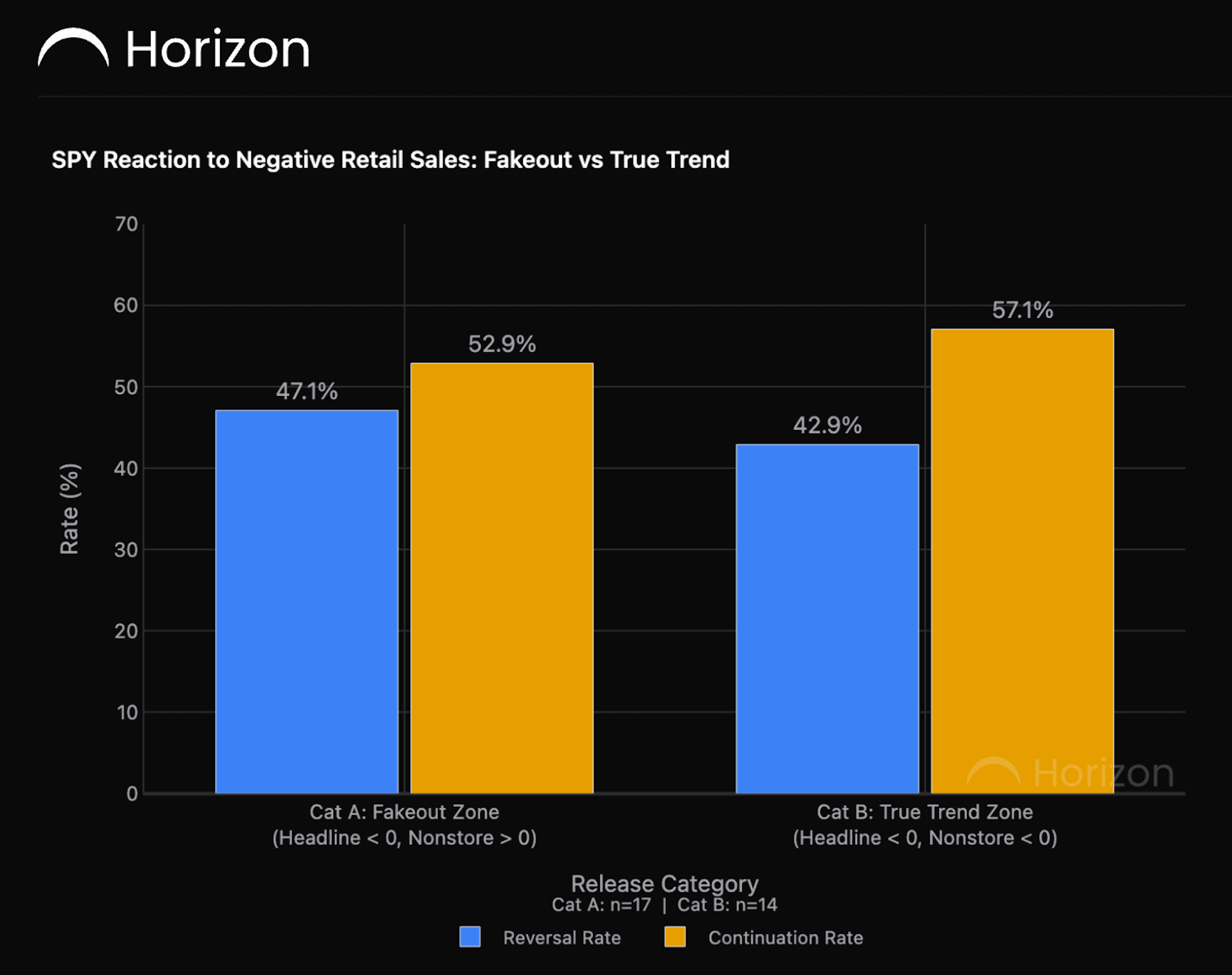
When headline retail sales were negative but e-commerce remained positive, the initial five-minute SPY move reversed by 9:30 AM ET in 47.1% of cases.
The move continued in 52.9%.
That is essentially a coin flip.
There was no meaningful edge from the internal divergence.
Broad weakness did not produce reliable continuation either
When both headline retail sales and e-commerce were weak, the initial move continued 57.1% of the time.
It reversed 42.9%.
That is slightly more directional, but still nowhere near strong enough to call a reliable signal.
The market remained noisy regardless of the sub-component.
Why the narrative sounds better than the data
A strong e-commerce number can support a "resilient consumer" story.
That story may be economically relevant over time.
It does not appear to offer a useful short-horizon SPY signal immediately after the release.
The market is processing far more than one retail category.
Rates, inflation expectations, revisions, control-group sales and positioning all matter at the same time.
The first hour is mostly noise
The main result is not that e-commerce is irrelevant economically.
It is that the e-commerce split did not meaningfully improve short-term directional accuracy.
Within the first hour, negative retail sales releases behaved close to a coin flip regardless of whether nonstore sales were strong or weak.
The takeaway
Strong e-commerce does not reliably rescue a weak retail sales print as a short-term market signal.
Across 31 negative releases, the initial SPY move reversed nearly half the time whether e-commerce was strong or weak.
The narrative may sound convincing.
The trading edge is not there.
Share this post: