
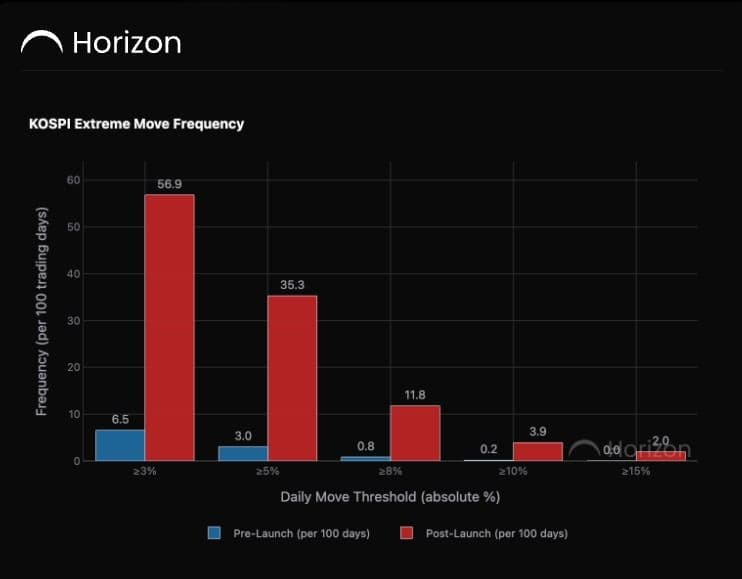
South Korea has become one of the most striking examples of how leveraged exchange-traded products can change market behaviour.
The original research focused on the growth of 2x leveraged ETFs and the extreme volatility surrounding the Korean equity market.
The core issue is mechanical.
Leveraged products have to rebalance.
When enough money is concentrated in them, that rebalancing can start feeding back into the market itself.
Leverage changes the size of the move
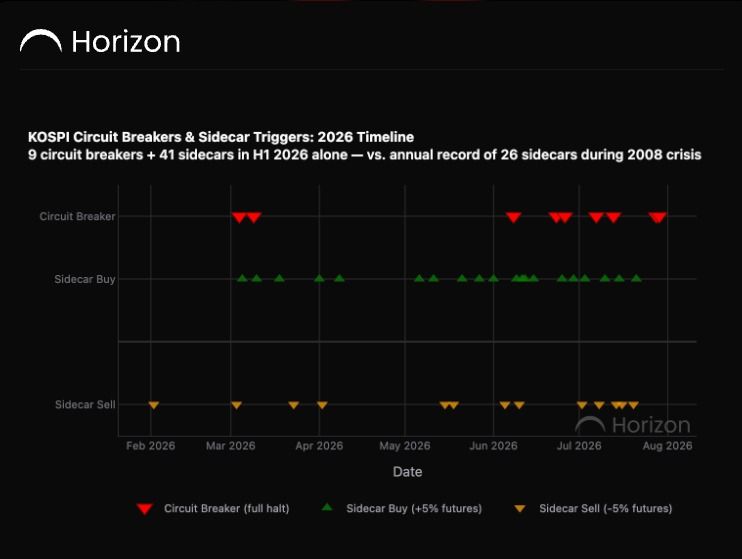
A 2x ETF is designed to deliver roughly twice the daily return of its underlying index.
To maintain that exposure, the fund must adjust its position as the market moves.
On strong up days, it may need to add exposure.
On sharp down days, it may need to reduce it.
That can reinforce the direction of the underlying move.
Daily reset products can create feedback loops
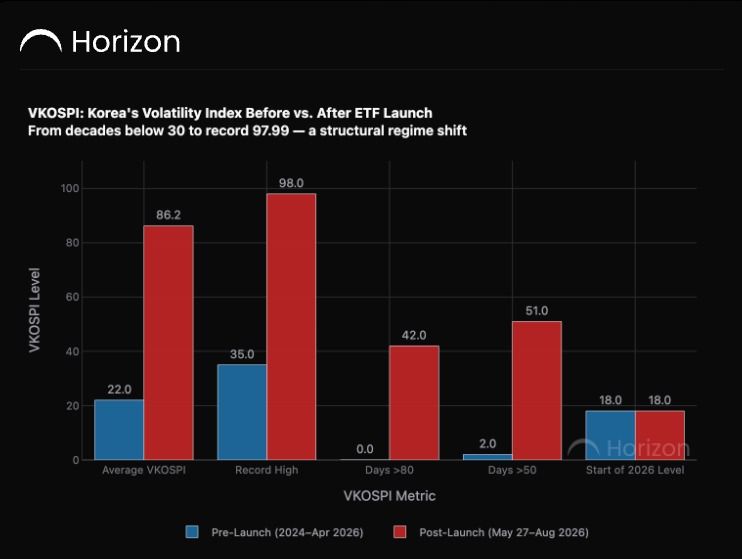
The effect matters most when the products become large relative to the market they track.
If leveraged funds represent a meaningful share of trading activity, their rebalancing can increase end-of-day demand or supply.
The result can be a feedback loop.
Price moves create required rebalancing.
The rebalancing creates more price pressure.
That is one reason leveraged ETF growth can matter for market structure even if every individual investor understands the product.
Volatility can become detached from fundamentals
The original research compared recent Korean volatility with major historical stress periods, including the 2008 crisis.
The broader point is not that leveraged ETFs alone caused every extreme move.
That would be too strong.
It is that a market with heavy leveraged-product participation can amplify volatility once stress begins.
The structure can make moves larger than the underlying fundamental news would otherwise imply.
Why this matters beyond South Korea
Leveraged ETFs are growing in many markets.
They are useful products when investors understand the daily-reset structure.
The market-level consequences become more important as assets under management grow.
At sufficient scale, product design can stop being just an investor issue and become a market-structure issue.
The takeaway
South Korea is a useful case study in what happens when leveraged ETFs become large enough to matter.
The products do not create every market move.
They can amplify existing ones through mechanical rebalancing.
That makes the growth of leveraged products relevant not only to the investors buying them, but to everyone trading the underlying market.
Share this post: