Bloom Energy jumped roughly 5% to 6% after being announced for inclusion in the S&P 500.
That move makes intuitive sense.
Index funds eventually need to own the stock, passive demand is coming and the announcement itself puts the company in front of a much larger group of investors.
The tempting trade is obvious: buy the announcement and hold until the stock officially enters the index.
Historically, that has not worked particularly well.
377 S&P 500 additions
We looked at 377 additions to the S&P 500 since 2006.
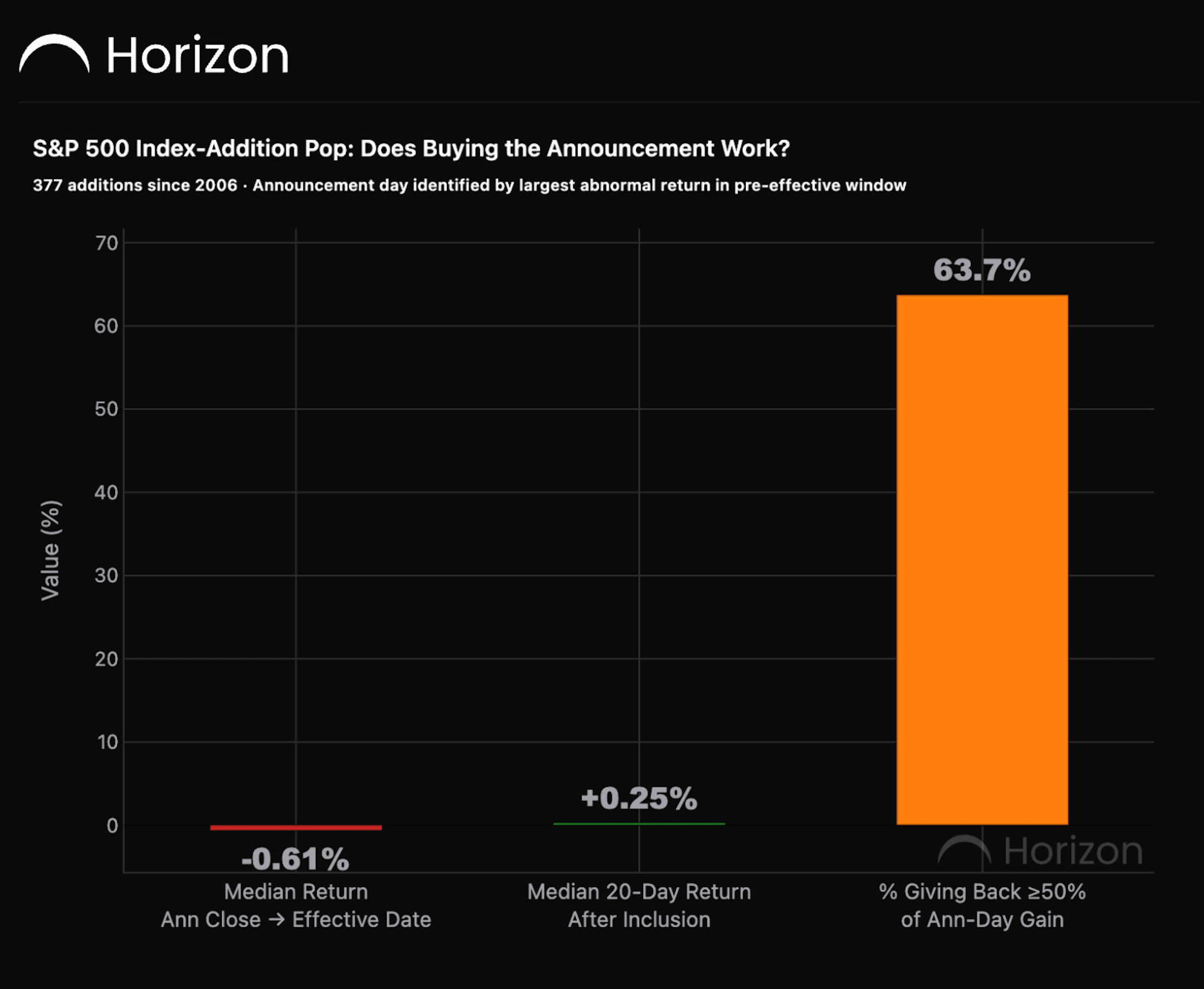
The median return from the announcement-day close to the effective inclusion date was -0.61%.
Only 43.8% of stocks were positive during that waiting period.
So although the announcement often produces an immediate jump, the typical stock actually drifted lower before it formally entered the index.
Most stocks gave back a large part of the pop
Nearly 63.7% of additions gave back at least half of their announcement-day gain before the effective date.
That is the key result.
The market appears to price the forced-demand story very quickly.
By the time a trader buys after the announcement move, much of the obvious information may already be reflected in the price.
The later passive buying is real, but everyone knows it is coming.
The effect has weakened further
Since 2016, the pattern became even less attractive.
The median announcement-to-effective return fell to -1.25%.
The proportion of stocks giving back at least half of the initial pop increased to 67.6%.
That suggests the event has become increasingly efficient.
As index-rebalancing strategies and event-driven trading have become more widely understood, the easy part of the move appears to have shifted closer to the announcement itself.
Inclusion did not create a strong second leg either
We also looked at performance after the stock officially entered the S&P 500.
The median return over the following 20 trading days was only +0.25%.
That is essentially flat.
So the data does not show a reliable second opportunity after inclusion either.
Why the trade is harder than it looks
The mechanical demand from index funds is real.
The mistake is assuming that predictable demand must produce predictable returns after the announcement.
Markets can price future flows before they happen.
Event-driven funds can also buy ahead of passive index funds, then sell into the eventual rebalance.
That can create exactly the pattern we see in the data: a sharp announcement move followed by weaker returns into the effective date.
The takeaway
The S&P 500 addition pop is real.
Buying after that pop has historically been much less attractive.
Across 377 additions since 2006, the median stock lost 0.61% from the announcement-day close to the effective date, and almost two-thirds gave back at least half of the initial gain.
The index inclusion matters.
The problem is that the market usually knows that before you buy it.
Share this post: