
The U.S. Strategic Petroleum Reserve is close to a historical extreme.
As of August 2026, inventories sit at 289.7 million barrels.
That is around the 0.57th percentile of the full 1982 to 2026 history.
At the same time, WTI 20-day realised volatility is elevated at roughly the 83rd percentile.
The obvious question is whether the depleted reserve is making oil more volatile.
Historically, the answer is barely.
The relationship exists, but it is tiny
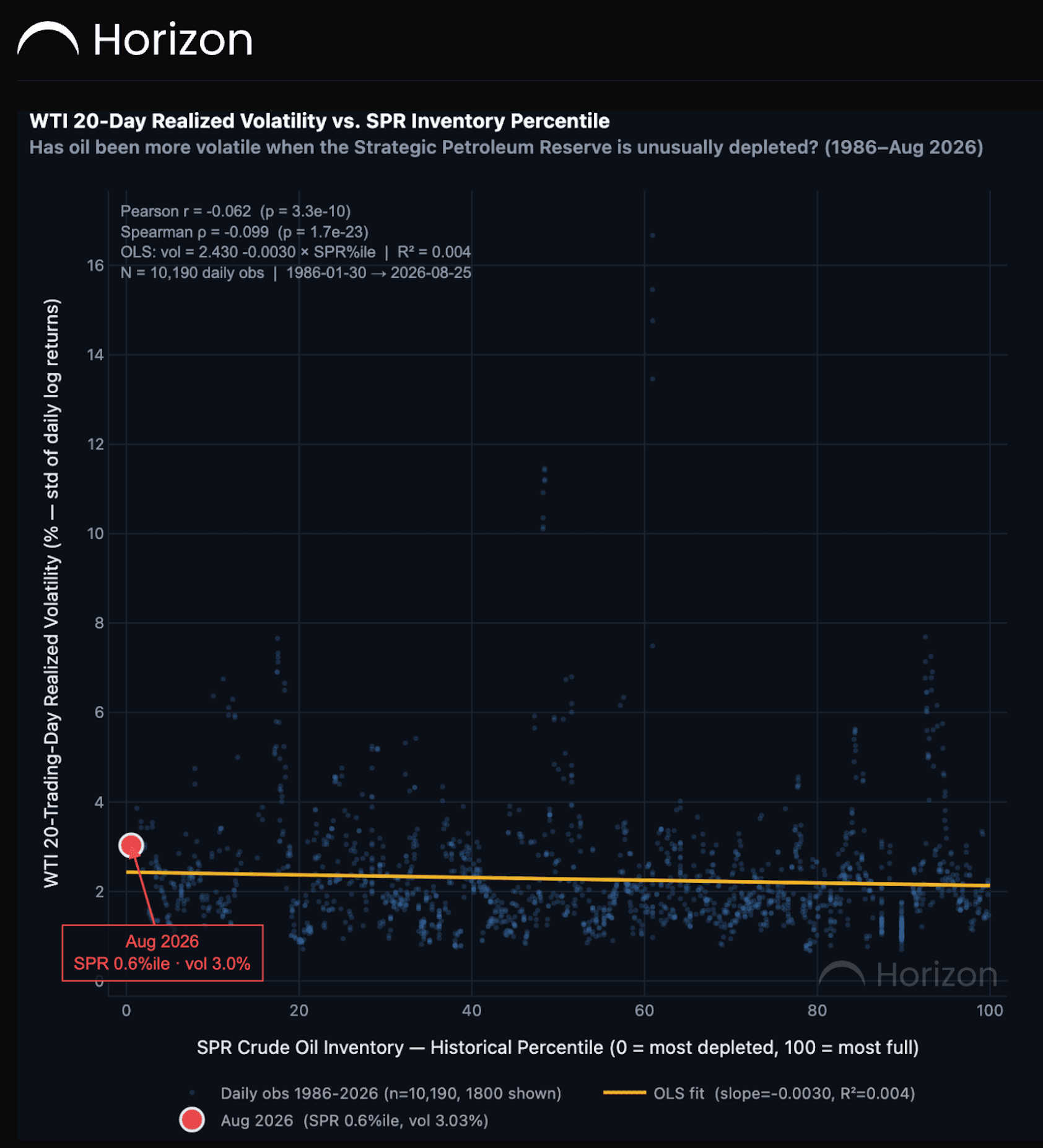
Across roughly four decades of data, the relationship between SPR inventory levels and WTI 20-day realised volatility is negative.
Lower inventories are associated with slightly higher volatility.
The relationship is statistically significant.
Economically, it is almost meaningless.
The Pearson correlation is -0.062.
The R-squared is only 0.004.
That means SPR levels explain about 0.4% of the variation in oil volatility.
Even a full depletion barely changes the estimate
Moving from a completely full to a completely depleted SPR predicts only around a 0.30 percentage-point increase in daily realised volatility.
That is very small relative to the swings oil routinely experiences because of geopolitics, OPEC decisions, wars, recessions and supply disruptions.
The reserve matters strategically.
Its inventory level is not a strong standalone volatility signal.
The relationship is not even cleanly monotonic
Oil volatility has historically been elevated at both very low and very high SPR inventory levels.
That is another clue that causality is not simple.
The reserve often moves because policymakers are responding to the same shocks already driving the oil market.
A supply crisis can increase volatility and trigger SPR releases at the same time.
That can make low reserves and high volatility appear related even if one is not directly causing the other.
Today's setup is still unusual
The current configuration is extreme.
The SPR is close to a record low while oil volatility is elevated.
That matters for policy flexibility because the government has less inventory available to deploy during another major supply shock.
But that is different from saying low reserves automatically make daily oil prices more volatile.
The historical data does not support that stronger claim.
The takeaway
A depleted Strategic Petroleum Reserve is not, by itself, a meaningful oil-volatility signal.
The statistical relationship is real but tiny, with SPR levels explaining only about 0.4% of volatility variation.
The more likely story is that both low inventories and high volatility often reflect the same underlying supply shocks.
The reserve level matters strategically.
It does not explain much of the day-to-day behaviour of oil prices.
Share this post: