
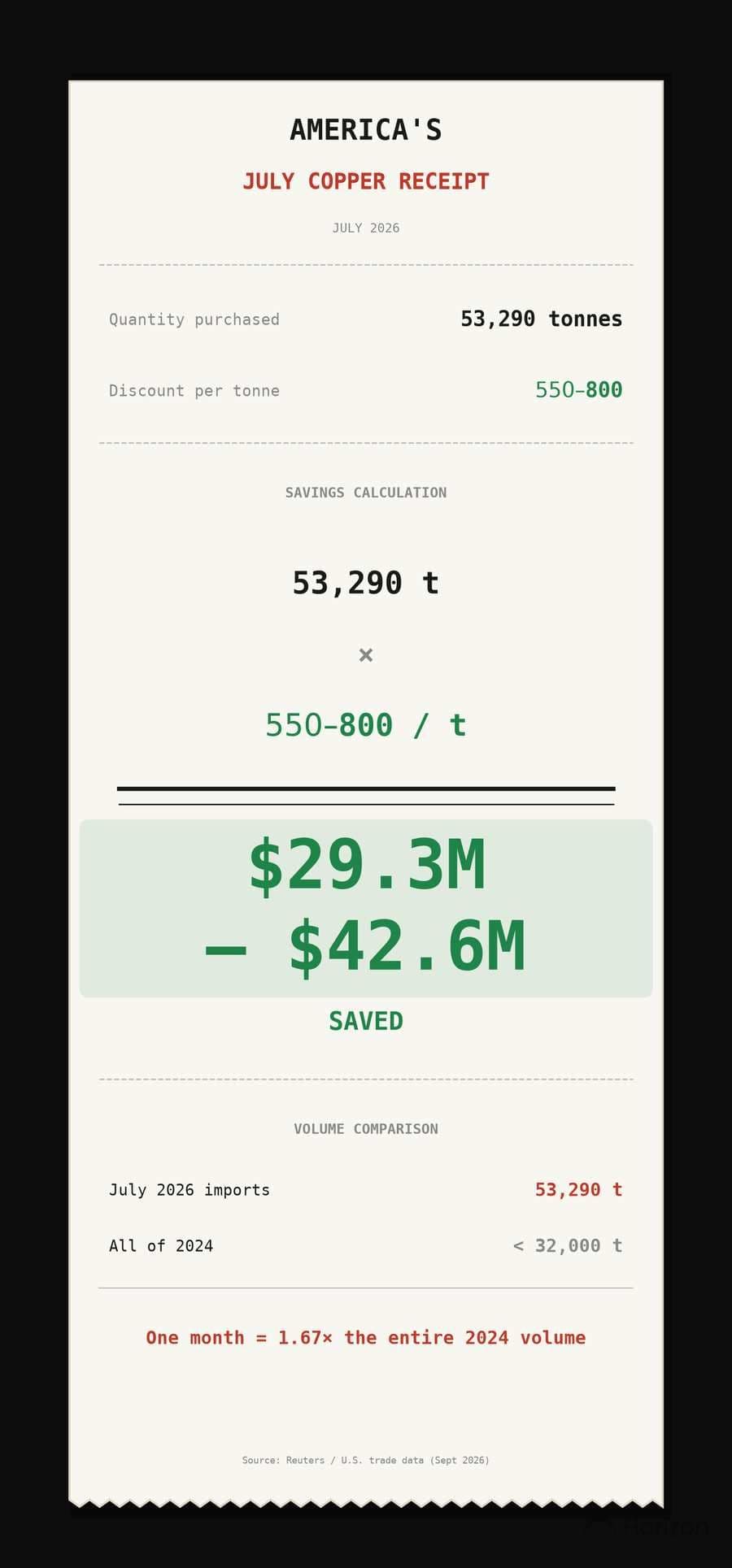
In July 2026, the United States imported 53,290 tonnes of Congolese copper.
That was more copper from the Democratic Republic of Congo in a single month than the U.S. imported during all of 2024.
The comparison is striking.
July alone was 1.67 times the entire 2024 volume.
The price incentive was substantial
Congolese copper was reportedly sold at a discount of roughly $550 to $800 per tonne relative to the LME benchmark.
Applied to July's 53,290 tonnes of imports, that implies an estimated price advantage of between $29.3 million and $42.6 million for buyers.
That is large enough to change sourcing behaviour.
When commodity discounts become meaningful, trade routes can adjust very quickly.
Trade flows can move faster than narratives
Commodity supply chains are often discussed as if they are slow-moving and fixed.
The July data shows otherwise.
U.S. buyers shifted sharply toward Congolese supply once the economics became attractive enough.
That does not necessarily mean the new flow will persist at the same rate.
But it does show how responsive buyers can be to pricing differences.
Why the Congo matters
The Democratic Republic of Congo is already strategically important to global metals supply.
Copper is increasingly relevant to electrification, data centres, grid investment and industrial infrastructure.
That makes access to discounted supply especially valuable when demand is strong.
The July import surge is therefore more than a trade-statistics curiosity.
It shows how quickly the U.S. can redirect purchasing when a major producing region becomes economically attractive.
The takeaway
In one month, U.S. buyers imported more Congolese copper than they did in all of 2024.
At the reported discount, that may have translated into roughly $29 million to $43 million of pricing advantage.
The bigger point is how fast commodity trade flows can change when the incentive becomes large enough.
July was not just a strong month for Congolese copper imports.
It was a reminder that price can redraw supply chains surprisingly quickly.
Share this post: