
Yen volatility gets a lot of attention whenever global markets become unstable.
But volatility alone is not the useful signal.
The direction of the yen matters.
The clearest risk-off pattern appears when USD/JPY volatility is high and the yen strengthens.
That is the classic carry-unwind setup.
What happens during carry unwinds
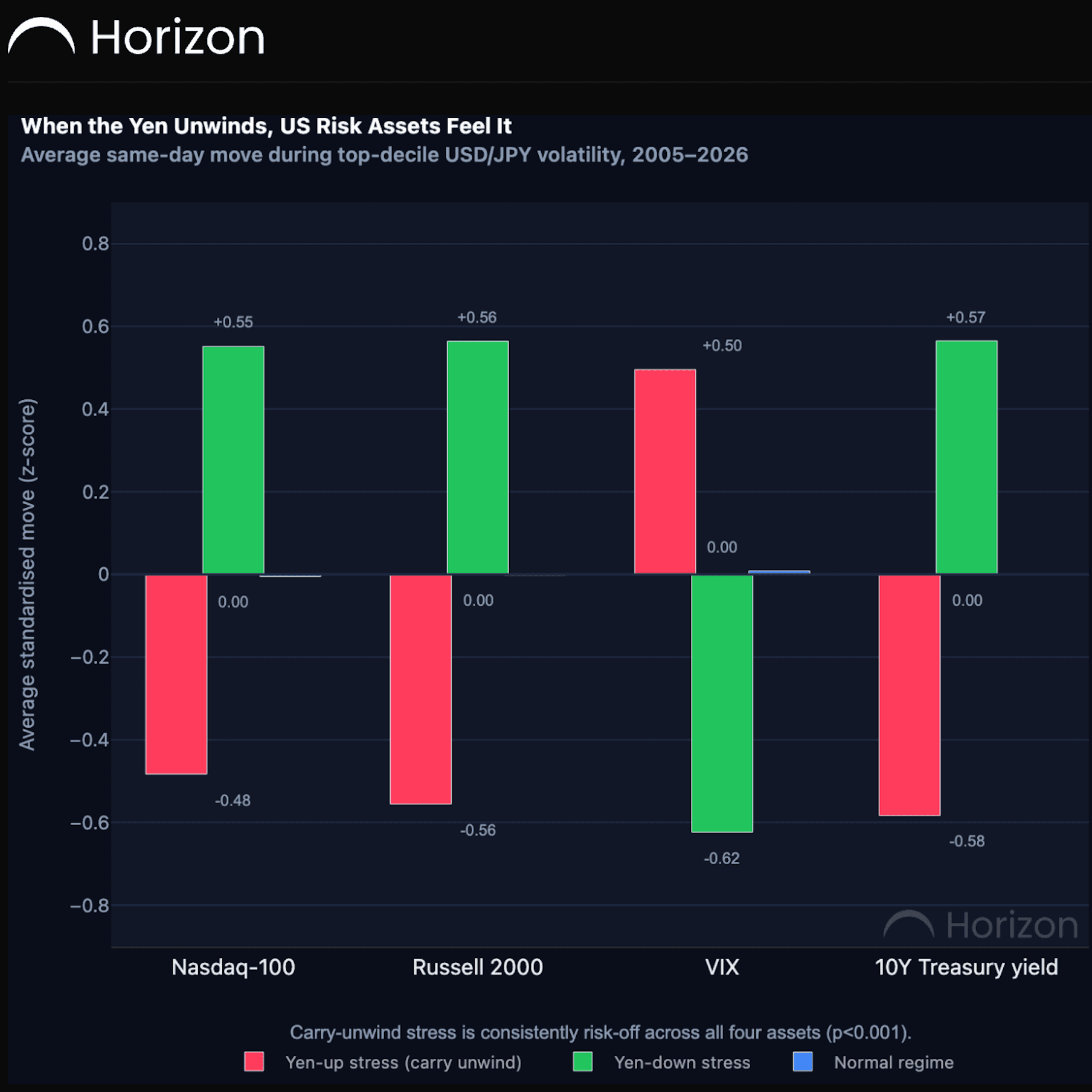
We looked at top-decile USD/JPY volatility regimes since 2005 and separated them by direction.
When high volatility was paired with yen strength, U.S. risk assets moved lower together.
Average same-day moves were:
- Russell 2000: -0.82%
- Nasdaq-100: -0.61%
- VIX: +0.95 points
- U.S. 10-year yield: -3.27 basis points
All four differences between carry-unwind days and normal market days were statistically significant at p < 0.001.
That is a very clean cross-asset pattern.
The Russell 2000 was hit harder than the Nasdaq
The surprising result was where the equity weakness was strongest.
The Russell 2000 was more consistently affected than the Nasdaq-100.
That matters because the public narrative around yen carry trades often focuses on high-growth technology.
The data suggests smaller U.S. companies can be even more sensitive during genuine unwind episodes.
Why direction matters
A volatile yen can mean two very different things.
If the yen weakens sharply, carry trades may still be expanding.
If the yen strengthens sharply, leveraged positions funded in yen can come under pressure.
Those two regimes should not be treated as the same signal.
When they are lumped together, the effects partially cancel out.
That is why yen volatility by itself looks much less useful.
What a carry unwind actually represents
For years, investors have borrowed cheaply in yen and deployed that capital into higher-yielding or riskier assets.
When the yen suddenly strengthens, those trades become more expensive to maintain.
Investors can be forced to reduce exposure, which creates a broad risk-off response across equities, volatility and bonds.
That mechanism fits the historical results.
The takeaway
High yen volatility alone does not tell us much.
The useful signal is high volatility combined with yen strength.
In those regimes, U.S. risk assets have historically moved risk-off together, with the Russell 2000 showing even more consistent weakness than the Nasdaq-100.
The direction of the currency is what turns volatility into a carry-unwind signal.
Share this post: